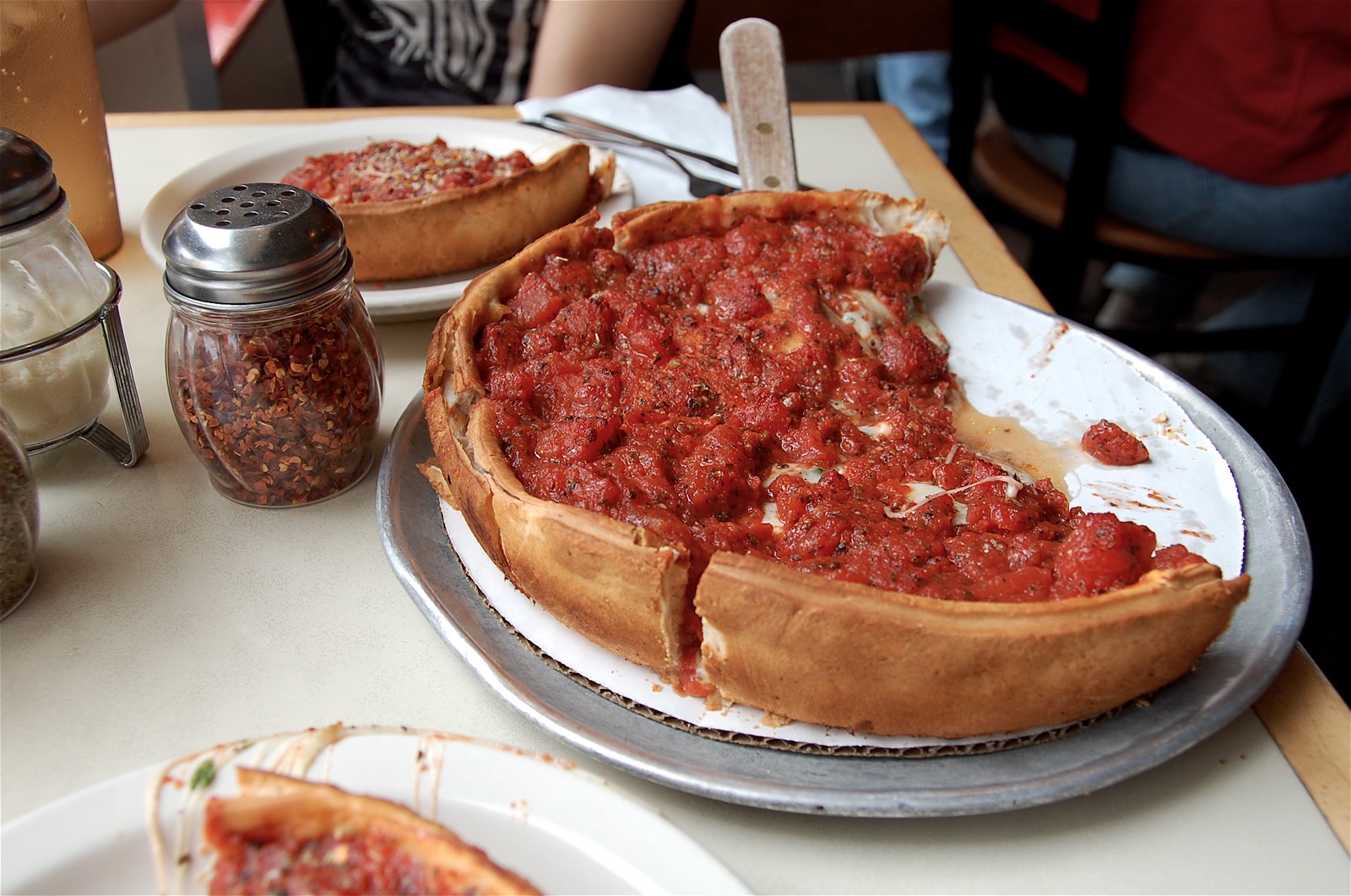
Chicago deep dish is sometimes described as thick-crust pizza, but most of its height comes from architecture, not a giant loaf of dough. The crust lines the base and walls of a round, high-sided pan. Cheese and other fillings occupy the interior. Tomato often appears toward the top, where it is less exposed to the direct heat that could burn cheese during a longer bake. The result is deep because it contains layers, not simply because the bread is thick.
Why the order of layers matters
A conventional thin pizza exposes cheese and toppings to intense heat for a relatively short time. Deep dish remains in the oven longer because heat must move through a larger mass. Putting cheese beneath tomato and other layers helps protect it and controls how moisture migrates through the pie. Restaurants have their own sequences, but the construction is always a heat-management problem.
The crust is also distinct from a tall, airy pan pizza. It may be crisp or crumbly at the edge and firm enough at the base to support a heavy wedge. It should not be confused with the flaky lids of stuffed pizza, another Chicago-associated form with a separate layer of dough over the filling. If a menu lists both, read the description rather than treating the names as synonyms.
Plan around the bake, not the notification
A deep-dish pizza commonly requires much more oven time than a thin pie. Exact timing varies by restaurant, size, order volume and whether the pizza starts from a prepared state. The practical rule is simple: consult the restaurant's current estimate before organizing the evening. If you have a fixed schedule, place the order early enough to absorb uncertainty without pressuring staff or keeping the finished pizza waiting.
Carryout can reduce the final travel interval, but the pie still retains considerable heat. Use a stable, level space in the vehicle and avoid stacking cold items on top. Once home, let the restaurant's cutting or resting instructions guide you. Cutting immediately can release filling before it has settled; waiting too long in a closed box encourages condensation.
Portion planning without misleading math
Diameter alone is a poor basis for comparing deep dish with thin pizza. A smaller deep pie may contain more cheese, sauce and filling per wedge. Appetite, toppings and side dishes all change the answer, so national “slices per person” rules are unreliable. Start from the restaurant's stated serving guidance, then adjust for your group.
- Ask what size means. Confirm diameter, number of slices and whether the restaurant offers serving guidance.
- Account for richness. A meat-heavy build is substantially different from a vegetable-forward pie.
- Add contrast. A fresh or acidic side can be more useful than a second equally rich appetizer.
- Order fewer variations. Splitting toppings may be limited by the layered build; check before assuming half-and-half is available.
Choosing toppings that serve the structure
Sausage, peppers, onions, spinach and mushrooms are common deep-pizza ideas, but ingredient preparation matters. Vegetables can release water; meats add fat; dense layers slow heat movement. A good kitchen accounts for those effects. As a customer, restraint is still valuable. Choose a combination designed by the restaurant or limit custom additions until you understand its base pie.
For allergens, nutrition and dietary restrictions, speak directly with the restaurant and use current first-party information. A visible tomato top reveals nothing conclusive about the dough, cheese, preparation surfaces or cross-contact. Deep dish is especially difficult to modify after assembly, so communicate requirements before the order enters production.
Delivery behavior and the first slice
Deep dish retains heat well, which helps on a moderate trip. Yet its moist filling and enclosed box can soften the crust. A cut pie may also shift if carried at an angle. For the cleanest structure, favor a nearby restaurant, keep the box level and serve on plates rather than continuing to eat from cardboard over a long period.
Evaluate the first wedge by layers. Is the bottom baked through? Does the wall remain intact? Can the cheese and filling be separated with a fork rather than running like soup? A little movement is natural in a hot, abundant pie; complete structural failure is different. Taste the crust on its own, because it is doing both culinary and mechanical work.
Leftovers may be a feature, not a failure
Deep dish can make planned leftovers sensible. Refrigerate them promptly in shallow, covered storage. Reheat gradually enough to warm the center while restoring the base; a hot oven is often more even than blasting the exterior. Consult current USDA food-safety guidance for safe storage and reheating, and discard pizza left out beyond safe limits.
The right expectation transforms the style. Chicago deep dish is not a thin pizza made unusually tall. It is a layered pan meal with a longer production time, greater portion density and its own service rhythm. Give it the clock and table space it needs.