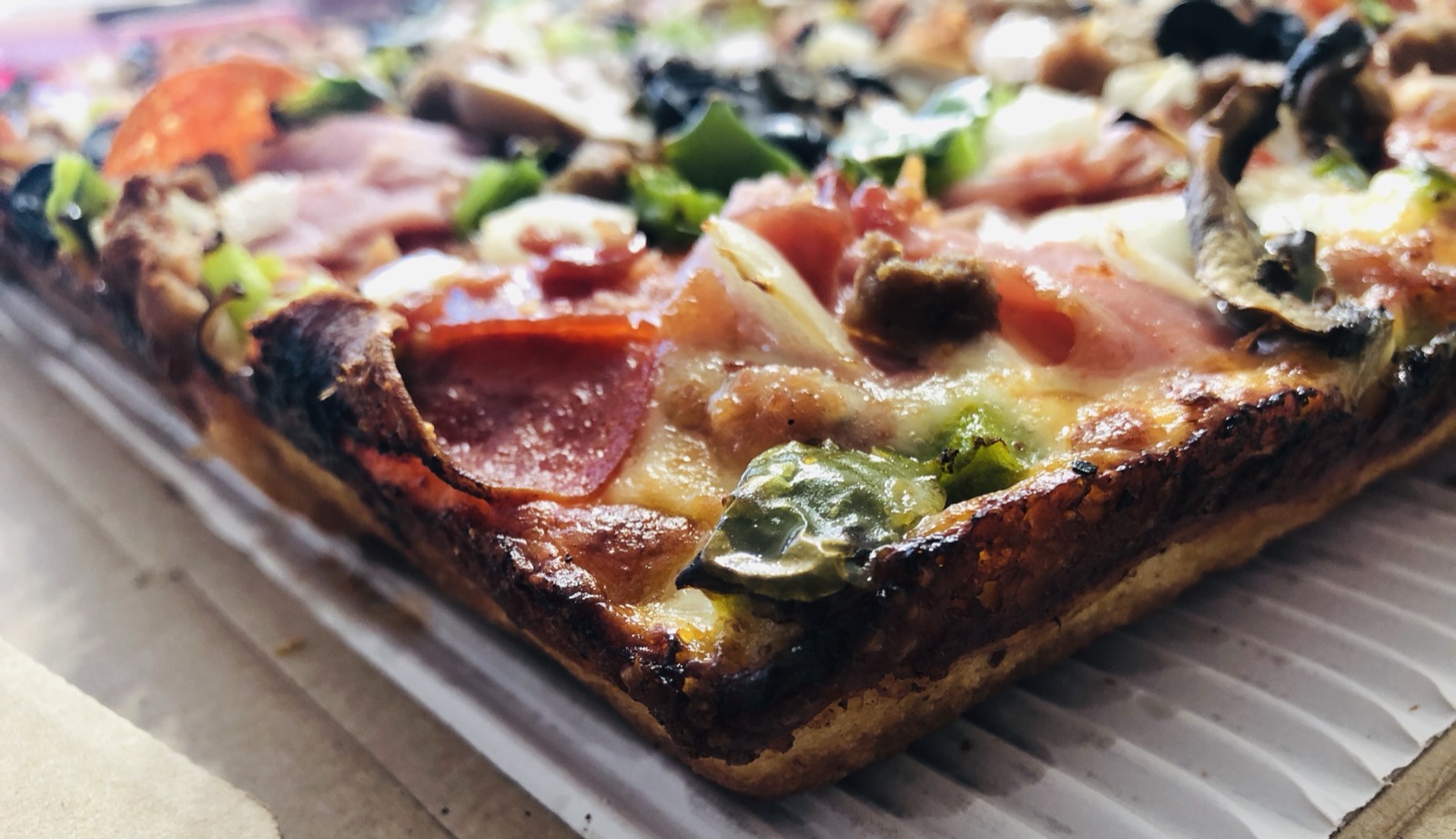
A Detroit-style pizza announces its geometry before its flavor. It is baked in a rectangular metal pan and cut into squares, producing corner, edge and center pieces with meaningfully different ratios. Cheese is spread to the boundary rather than held back behind a bare rim. Against the hot pan, that cheese melts, darkens and fuses into a lacy, savory edge. Beneath the toppings, a relatively thick dough rises into a light crumb that should feel aerated rather than leaden.
The edge is a process, not decoration
Descriptions sometimes treat the caramelized perimeter as if a finished strip were attached to ordinary pizza. In reality, the edge comes from contact among cheese, fat, dough and hot metal. The pan controls the shape and concentrates heat. Cheese placed to the sides forms a continuous border, while the base benefits from oil and direct pan contact.
Color can range from deep gold to brown, but darker does not automatically mean better. A scorched edge tastes bitter and a pale one may lack crunch. The goal is a brittle first resistance that gives way to a chewy, flavorful layer. Because every edge piece contains more of this feature, groups may want to divide corners rather than assume every square is equivalent.
What a good cross-section reveals
Turn a piece sideways. The interior should show a network of bubbles and some vertical lift. A compact, cake-like interior may come from under-fermentation, rough handling or an overly heavy topping load. At the base, look for browning and firmness without a hard fried shell. The contrast matters: crisp perimeter and bottom, tender interior, moist topping layer.
Sauce placement changes the bite
Many examples apply sauce in stripes or spoonfuls over the cheese, although restaurants vary. The placement keeps some sauce visually and texturally distinct while allowing cheese to contact the pan edge. It also changes the order in which heat and moisture reach the dough. Do not use sauce-on-top as the only authenticity test, but do expect the builder to manage moisture deliberately.
Toppings that release water can challenge the crumb. A restaurant may precook vegetables, use restrained portions or adjust the bake to preserve the base. When ordering, one or two distinct toppings usually let you appreciate the edge and interior better than a fully loaded combination.
Ordering corners, centers and whole pies
Rectangle size and cut pattern affect the number of coveted corners. If the menu does not state portioning clearly, ask how many pieces come in the pan and think in terms of appetite rather than round-pizza diameter. A small rectangular pizza is difficult to compare directly with a large thin round pie because height and density differ.
- For first-timers: choose a simple build, then share one piece of each position.
- For edge fans: a smaller pan may provide a higher perimeter-to-center ratio, but restaurant pan dimensions vary.
- For groups: pair the rich rectangle with a lighter salad or simpler second pizza rather than only adding toppings.
- For dietary needs: confirm ingredients and cross-contact directly; cheese at the edge can make substitutions structurally significant.
How well does it travel?
Detroit style retains heat better than a very thin slice, but the box still creates a humid environment. The cheese edge may soften and the oiled base may lose definition over a long trip. Carryout can shorten the interval and gives you control over when the pizza leaves the restaurant. On arrival, remove pieces from the box rather than letting them sit in trapped steam throughout the meal.
For leftovers, refrigerate promptly. A preheated oven or skillet can re-establish some base crispness, whereas a microwave emphasizes softness. Follow current government food-safety guidance for storage and reheating; texture advice is never a substitute for safe handling.
Detroit style versus generic pan pizza
Both use a pan and can have a thicker crust, so the categories overlap in casual conversation. Detroit style is more specific: rectangular form, airy crumb and cheese carried to the edge are central clues. Generic pan pizza may be round, may leave a conventional exposed rim and may pursue an evenly plush texture rather than a dramatic cheese perimeter.
That specificity makes the style easy to identify but hard to reduce to one feature. The best version is not merely a vehicle for a crunchy edge. It is a carefully managed set of contrasts: square geometry, light interior, fried underside, molten center and dark savory border.