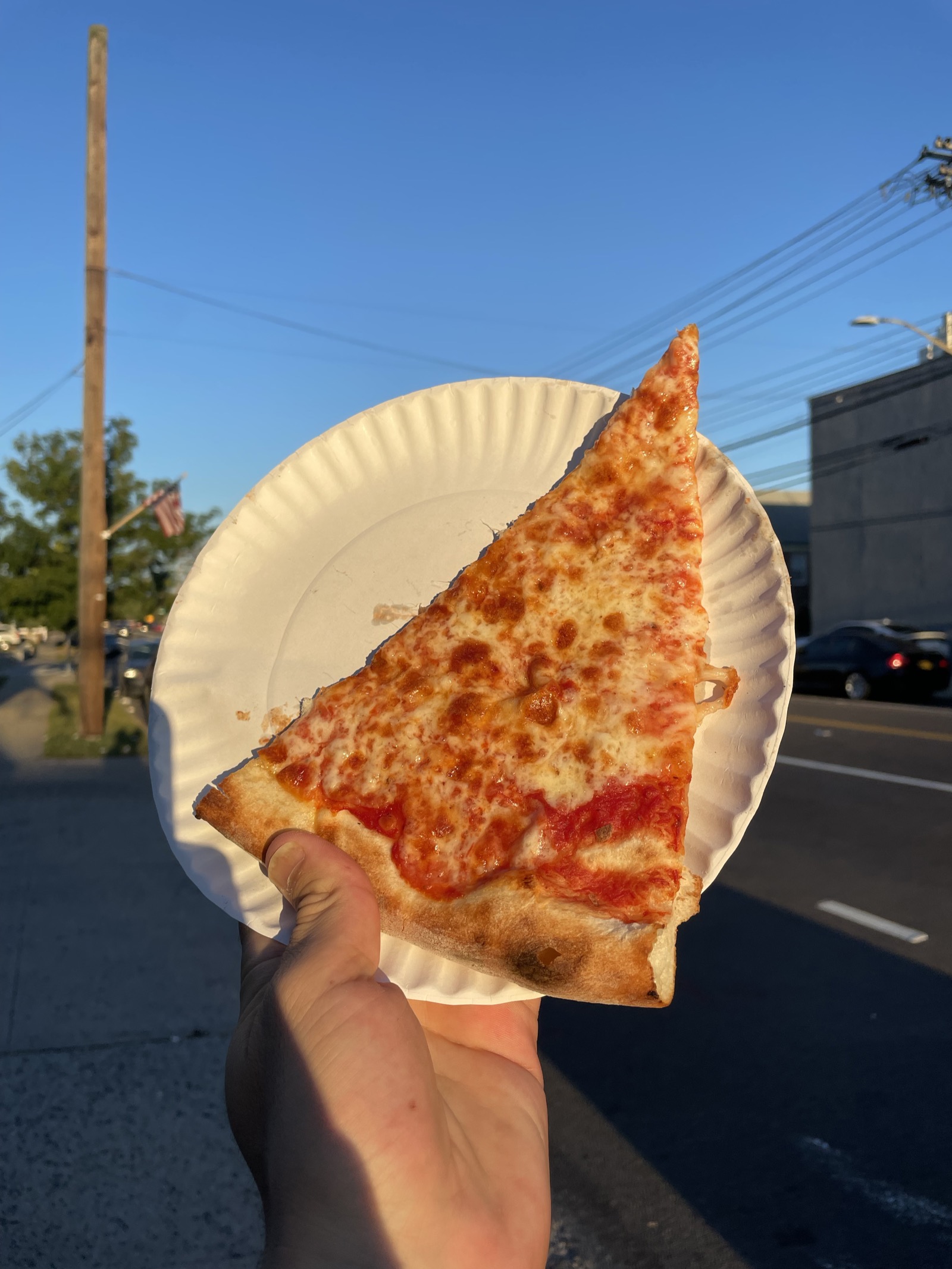
New York pizza is often reduced to a slogan: big, thin and foldable. Those words are correct, but they become useful only when treated as a system. A broad diameter creates long wedges. A relatively thin center keeps each wedge light enough to eat without a knife. A developed dough and hot bake give the underside enough strength to avoid behaving like wet cardboard. The raised rim contributes chew and a dry place to grip. Fold the slice lengthwise and the curve becomes a beam, adding stiffness exactly where the slice needs it.
What to look for before the first bite
Lift the tip. A slight dip is normal; total collapse suggests either too much moisture or a crust that has softened in the box. Look underneath for an evenly baked surface rather than a pale, doughy center or isolated black patches. The rim should be modest compared with many modern artisan pies. Inside, it may show small irregular pockets, but New York style is not defined by an enormous inflated border.
The cheese layer usually reads as continuous rather than sculptural. Sauce supports it with acidity and seasoning, but should not make the slice soupy. Oil on the surface is not automatically a flaw—cheese and cured toppings release fat—but a pool that saturates the crust will reduce the crisp-versus-pliant balance.
Why a fresh slice differs from a boxed pie
A slice shop often reheats an individual wedge in a hot oven. That second exposure can refresh the underside and melt the cheese just before service. A whole delivery pie leaves the oven once, enters a closed cardboard environment and releases steam throughout the trip. The same recipe can therefore feel crisper at the counter than at home.
If texture is the priority, distance matters. A nearby carryout order gives you greater control over timing and lets you inspect the box when it is handed over. For delivery, choose a realistic radius and avoid scheduling the pizza far ahead unless the restaurant explains how it handles timed orders. Opening the lid repeatedly on the trip is not ideal for heat retention, but a brief vent after arrival can stop additional condensation.
How to order it intelligently
- Begin modestly. A cheese or pepperoni pizza makes the crust-to-topping relationship easy to judge. Heavy vegetables and multiple meats increase moisture and weight.
- Request doneness carefully. Some restaurants accept a request for a slightly longer bake; others cannot guarantee it during busy service. Treat it as a request, not a universal secret code.
- Respect the clock. Be ready at pickup and track delivery notifications. Five avoidable minutes in a closed box can matter more than a minor topping choice.
- Compare like with like. If evaluating prices, use the same size, toppings and fulfillment method through each channel, then compare the final total.
Good pairings and common overloads
New York-style crust works well as a platform for restrained, familiar combinations because each wedge remains portable. Pepperoni, sausage, mushrooms or a single green vegetable can add contrast without changing the architecture. Very wet fresh mozzarella, uncooked watery vegetables and a crowded “everything” build may still taste good, but they demand more from a thin center. When choosing several toppings, ask whether each adds a distinct flavor or only more mass.
For a group, one simpler pie and one specialized pie is often safer than making every pizza maximal. It also separates dietary requirements more clearly. Anyone managing a serious allergy should contact the restaurant directly and review current ingredient and cross-contact information; the appearance of a simple pizza does not establish that it is allergen-free.
Leftovers: restore heat, do not merely add it
Refrigerate leftovers promptly in a covered container. For reheating, a skillet or hot oven can restore some bottom texture better than a microwave alone, though the correct method depends on equipment and food-safety circumstances. Heat food thoroughly and use current USDA guidance for storage times and safe temperatures rather than relying on internet folklore. If the pizza has remained at room temperature for an unsafe period, reheating does not reverse every risk.
Ultimately, the New York slice is a study in controlled contradiction: thin but not fragile, crisp but not rigid, generous in area but economical in thickness. Order close to the oven, keep the topping load purposeful and eat while that balance still exists.